


How to Trim Your Pet’s Nails Safely at Home
 N
N
ail trimming is one of those tasks most pet owners put off longer than they should. However, with the right tools and a calm approach, it’s a task that you can easily manage at home. At West Park Animal Hospital, we provide resources to pet owners to help them care for their pets in Cleveland, Ohio, and the surrounding areas. This guide covers everything you need to know for safe cat or dog nail clipping, what to do when things don’t go smoothly, and when it makes sense to hand it off to a professional.
Key Takeaways
- Overgrown nails are uncomfortable and can lead to joint and mobility problems over time.
- Most dogs need a trim every three to four weeks, while cats typically need one every four to six weeks.
- If your pet is anxious or aggressive, you should call a vet or groomer.
Why Nail Trimming is Important for Dogs and Cats
It’s easy to assume nail trimming is a cosmetic task. However, overgrown nails change how your pet bears weight. This puts stress on their joints and can affect their posture and gait over time. It’s time to trim your pet’s nails if:
- You can hear the nails clicking on hard floors
- The nails are visibly curling or growing sideways
- Your pet is limping, walking awkwardly, or reluctant to put weight on a paw
- Nails are snagging on fabric or carpeting (cats)
Severely overgrown nails can curve into the paw pad, causing pain and infected wounds that require veterinary treatment. Regular trimming helps prevent these complications.
What Do You Need Before You Start?
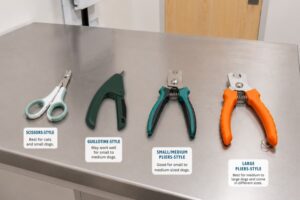
Having the right supplies ready makes the process smoother, especially if your pet gets anxious. Gather everything before you bring your pet over, so you’re not searching for something mid-trim:
- Clippers or a grinder: Scissor-style clippers are great for cats and smaller dogs. Guillotine-style clippers may work well for small to medium-sized dogs, while plier-style clippers are typically the best choice for medium to large dogs and are available in a variety of sizes. Grinders or rotary tools file the nail down gradually and are a good option for dogs who react to the snapping sensation of clippers.
- Styptic powder (also known as Kwik-Stop): This stops bleeding quickly if you cut the quick. If you don’t have any, cornstarch works in a pinch.
- Treats: Your pet’s favorite treats help your pet associate nail trims with something positive. Pet-safe lick mats with peanut butter for dogs or lickable purées for cats can also be a great option to help keep your pet distracted and calm during trimming.
- A second person: For wriggly dogs or nervous cats, having someone to hold and reassure your pet while you trim makes the process safer and calmer.
Whatever tools you use, make sure they’re sharp. Dull clippers crush the nail rather than cut cleanly, which is uncomfortable for your pet and can cause splitting.
How to Trim Dog Nails Step-by-Step
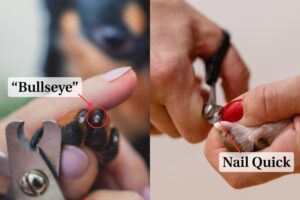
Before you start cutting your dog’s nails, you need to know what the quick is. The quick is the blood vessel and nerve that runs through the center of the nail. Cutting it hurts and causes bleeding. On dogs with light-colored nails, you can see the quick as a pink area inside the nail. On dark nails, it’s not visible, so you trim in small increments and watch the cut surface for a dark center (we call this the “bullseye”), which signals you’re close.
Follow these steps:
- Get your dog settled and comfortable, whether on your lap, on a non-slip surface, or with a helper holding them gently.
- Hold the paw firmly but without squeezing. Extend one nail at a time.
- Trim tiny amounts at a time, cutting at a slight angle before the quick.
- Work through each nail, including dewclaws. Reward your pet after each paw.
- Trim every three to four weeks. Regular trims cause the quick to recede over time, making future trims easier.
If your dog is resistant, it’s fine to do one paw per session. Shorter sessions help build their tolerance.
How to Trim Cat Nails Step by Step
Cat nail trims are usually quicker than dogs’ because the nails are smaller and translucent, making the quick easier to see. However, cats are often more nervous and resistant than dogs. These tips can help:
- Trim when your cat is calm or sleepy.
- If your cat is wiggly, wrap them loosely in a towel to limit their movement.
- Work on one or two paws at a time and stop before they become agitated.
- Gently press the toe pad to extend each nail before cutting.
Cut only the sharp, curved tip, about two millimeters above where the quick ends. Avoid the pink area entirely. Most cats need a trim every four to six weeks. However, indoor cats may need it more often since they don’t wear their nails down naturally.
What Do You Do if Your Pet Bleeds or Panics?
Even experienced groomers cut the quick occasionally. While it looks alarming, it’s not an emergency. If the nail bleeds:
- Apply styptic powder directly to the nail tip and hold gentle pressure for 30-60 seconds.
- If you don’t have styptic powder, press the nail into a small amount of cornstarch or a dry bar of soap.
- Keep your pet calm and off rough surfaces for a few minutes until the bleeding stops.
- Monitor the nail over the next day. Your pet may have some minor sensitivity. If the nail is swollen, hot, or doesn’t stop bleeding, contact your vet.
If your pet panics mid-trim, stop. Offer them a treat and try again another day. You can also reach out to a groomer or your veterinarian for help. Some pets do better with professional handling, and that’s okay.
Get Professional and Calm Support at West Park Animal Hospital
Home nail trims work well for a lot of pets, but not all of them. If your dog or cat is highly anxious, reactive, or won’t cooperate, professional cat and dog nail clipping is a safe alternative.
At West Park Animal Hospital, we provide nail trims as part of our wellness care for dogs and cats. Our team regularly handles nervous pets throughout West Park, North Olmsted, Berea, Rocky River, Lakewood, Fairview Park, and Cleveland, Ohio. To schedule an appointment or ask about our nail trim services, contact us today.
Nail Trimming FAQs
How do I know if my dog or cat’s nails are too long?
Signs that your pet’s nails are too long include hearing the nails clicking on hard floors or seeing the nails visibly curling or growing sideways. If your cat’s nails are snagging on fabric or carpets, they need to be trimmed.
Is a nail grinder better than clippers?
It depends. A nail grinder is generally better for getting smooth, rounded nails and reducing the risk of cutting the quick, while clippers are faster and quieter, making them better for pets that don’t like the sound of a nail grinder.
When should I let a veterinarian trim my pet’s nails instead of doing it myself?
You should let a veterinarian trim your pet’s nails instead of doing it yourself if the nails are severely overgrown, you’re uncomfortable doing it yourself, or if your pet experiences anxiety, fear, or aggression when you try to do it.
PET RESOURCES
Thank you for your Cleveland Hot List votes. We were voted #1 again for the 5th year in a row! We are happy to continue to serve the community and appreciate your support.
TOUR OUR HOSPITAL
MEET OUR STAFF


